The Key Elements of Smart Estate Planning
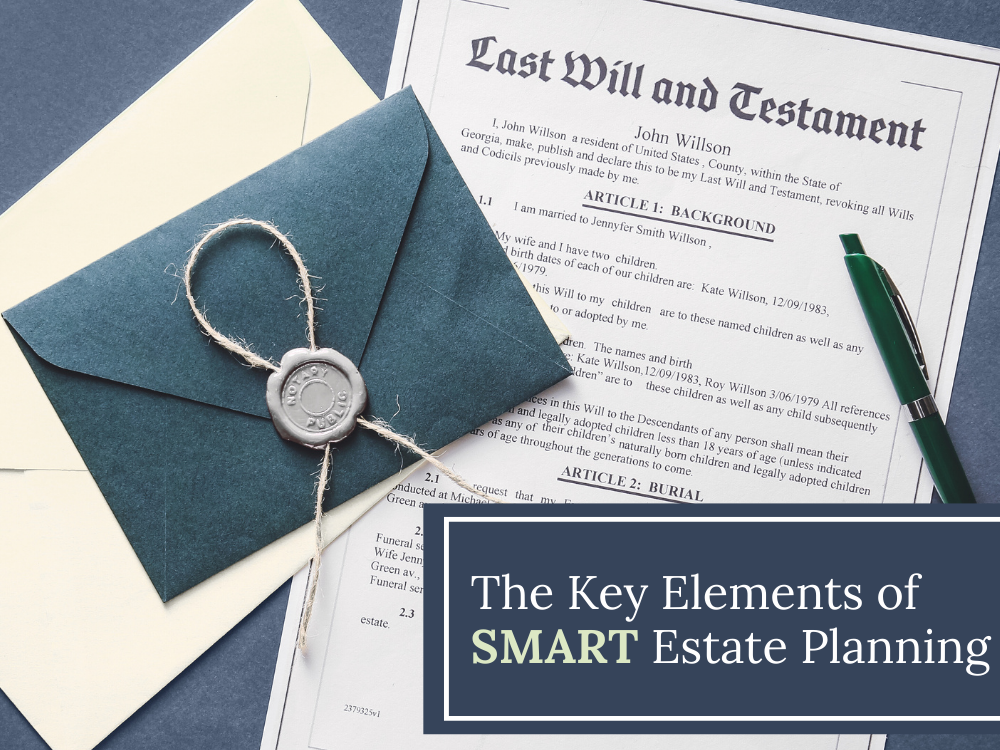
When it comes to planning for the future, family is often the number one priority. We find that many affluent investors have a “family steward” personality profile—they care deeply about how their wealth can help them take care of their loved ones.
If wealth and family are among your top issues, it’s likely you expect to use your assets to give your family a good life in the here and now—things like health care, travel and college tuition. But here’s a question: Have you thought nearly as much about positioning your assets so they’re ready and able to help the people you love after you’re gone?
Even if you’ve already started an estate plan, it may be outdated. Laws change, family dynamics shift, and assets evolve. The good news? By focusing on three key areas—wills, trusts, and fiduciaries—you can get your plan back on track.
Here are some ideas about how to do it.
The All-Important Will
Read this next sentence three times in a row: Everyone should have a will.
Got it? A will should be the basic foundation of every estate plan—the starting point for a well-conceived strategy to transfer assets at death.
A will identifies precisely what you want to have happen to your assets and estate. Dying without a will means you have decided that the state knows what’s best for you and your family. Having no will also can make the settling of your estate difficult, costly and highly publicized.
As with just about any financial document or strategy, there are both positives and negatives to a will. That said, we strongly believe the benefits of writing a will far outweigh the drawbacks.
Advantages
- You decide on the distribution of your hard-earned wealth
- A will forms the foundation of an estate plan, making it easier to coordinate other strategies (like trusts) that can help manage taxes.
- You specify who the fiduciaries will be.
Disadvantages
- You have to accept that one day—far in the future—you just might die.
- There is a legal cost associated with creating a will and an estate plan, though it’s typically modest compared to the potential cost of leaving no plan at all.
Trusts
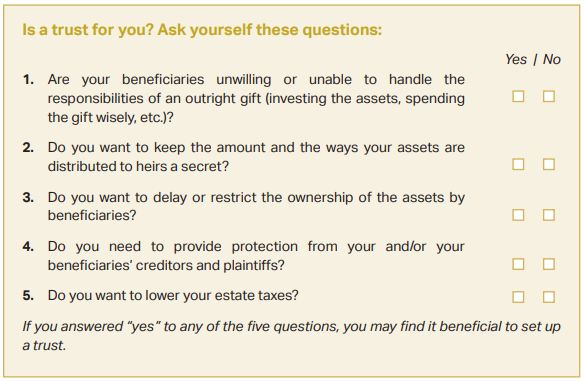
A typical second component of a smart estate plan is a trust. Essentially, a trust is simply a means of transferring property to a third party—the trust. A trust lets you transfer title of your assets to trustees for the benefit of the people you want to take care of—your selected beneficiaries, such as family members. The trustee will carry out your wishes on behalf of those beneficiaries.
Trusts can be used in a variety of ways to transfer wealth and determine how it will be deployed. Trusts also can be useful when it comes to wealth protection strategies—shielding your assets from plaintiffs and creditors who seek to (often unjustly) take them.
Types of Trusts
Broadly speaking, there are two types of trusts: living (established while you are alive) and testamentary (created by your will after you’ve passed).
Additionally, there are two fundamental trust structures.
- A revocable trust allows you to retain full control over the assets in the trust. You can add or take out money as well as change the terms of the trust. However, the assets will be included in your taxable estate upon death, so taxes will likely be due.
- An irrevocable trust is one to which you cannot make any changes. To obtain the tax savings that can come with a trust, you have to relinquish control of the trust while you are alive. When you transfer control of assets to an irrevocable trust, assets are removed from your estate, which may offer tax benefits under current law.
A Closer Look at Living Trusts
A living trust is widely used today to avoid the cost of probate. In the probate process, your representatives “prove” the validity of your will. The probate process also gives any creditors the opportunity to collect their due before your heirs get anything. There can be long delays in settling estates that go through probate. On top of all that, probate can be costly.
A living trust can potentially avoid or mitigate the effects of probate. It is a revocable trust that you establish and of which you are also typically the sole trustee. The assets in your living trust avoid probate at death and are instead distributed to your heirs according to your wishes.
Living trusts come with some attractive benefits, including the following:
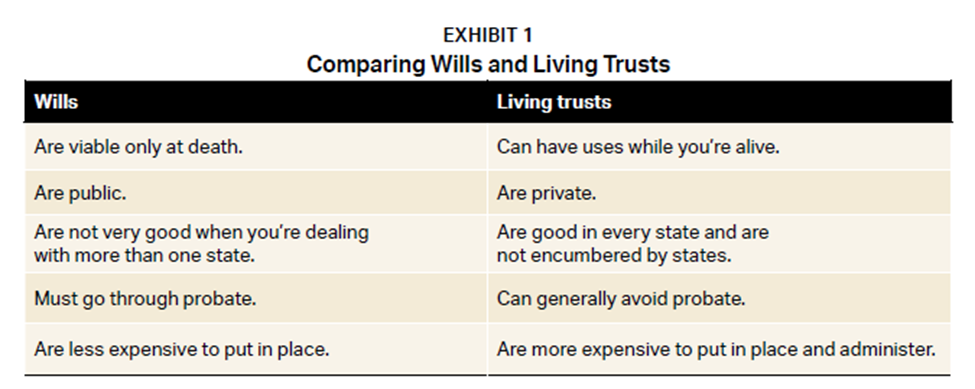
- In contrast to a will, a living trust provides privacy. Those not inheriting assets from you need not be told who has inherited what, unless someone chooses to tell them. With a living trust, professional management can come in to take care of administering the trust.
- If you own property in another state and fund it into your living trust, you will avoid a second probate on that asset.
- If you become incapacitated, a living trust can provide for private management of your assets and affairs and avoid public probate court involvement.
However, for a living trust to be meaningful, it must be funded. That is, the assets you want in the trust must be transferred to it. If you set up a trust but never fund it (it happens), probate will not be avoided. You can also write your will to ensure that assets you want in the trust that are not there when you die are transferred to your living trust.
Living trusts are sometimes said to be superior to a will, but that is not the case for everyone. It’s important that you understand how the two compare.
Is a living trust for you? It depends on your particular situation. Nevertheless, you should certainly consider it in consultation with a trusted advisor.
Important: Laws and regulations governing trusts can (and often do) change over time. Consult with a trusted professional about the latest developments regarding the rules of various types of trusts.
The Role of Fiduciaries
A fiduciary is a person or organization that is ethically and legally bound to act in the best interests of another person and to oversee that person’s finances.
Regarding your will, you need to name an executor. When it comes to trusts, someone (or some institution) has to be the trustee. And if you have children who are minors, it is imperative that you name guardians for them—people who will be willing and able to take care of your children if anything were to happen to you and your spouse.
Executors and Trustees
After you’re gone, wouldn’t it be nice if there were someone who would make decisions about your estate as you would have? When you name an executor of your will, this is possible.
An executor has a number of responsibilities, including:
- Collecting and organizing your assets
- Paying debts you owe
- Acting as a collection agency for money due to you
- Handling all necessary tax matters
- Ensuring that assets are distributed to beneficiaries
When you set up a trust, you are specifying how you want a situation managed in the future. It is the responsibility of the trustee to make sure that your wishes are carried out. The explicit responsibilities of the trustee vary depending on the nature of the trust you have set up, but they may include the following:
- Ensuring the proper tax forms are filed correctly and on time
- Making investment decisions
- Working with beneficiaries
Guardians
There are three key criteria that you need to consider in making this decision:
- Will the guardian(s) love your children?
- Are the guardian(s) capable of doing a good job raising your children?
- Do you think the guardian(s) are going to raise your children with the same morals and values that you have?
Sometimes the decision about who should be guardian of your children is obvious. Example: Your sister-in-law wants the responsibility, and you are confident she will do an excellent job, as she has the same views on raising children that you do.
That said, the “right” person or couple doesn’t always exist. Keep in mind that your decisions are not set in stone. As circumstances change, you should adjust your decisions accordingly. You can change your will or, for that matter, your entire estate plan if your situation changes.
Time for an Update?
It’s extremely common to review an existing estate plan and find that it’s been five years or longer since it was created. That’s more than enough time for changes in tax laws, your personal situation, or your family, to have made that plan outdated—and therefore out of touch with your wishes.
We recommend that your estate plan be reviewed every one to two years or after major life changes such as marriage, divorce, birth of a child, or the sale of a business. The review should be conducted by a wealth manager or tax professional who has estate planning experience and expertise—but who also takes the time to learn what’s changed since you put your solutions in place, assess how those changes might impact your strategy, and make recommendations for getting your solutions current and in accordance with your wishes.
It’s this combination of technical ability in estate planning coupled with a deep interest in truly getting to know you and your situation that we find tends to lead to the creation of the most effective estate plans.
VFO Inner Circle Special Report
By John J. Bowen Jr.
© Copyright 2022 by AES Nation, LLC. All rights reserved.
No part of this publication may be reproduced or retransmitted in any form or by any means, including but not limited to electronic, mechanical, photocopying, recording or any information storage retrieval system, without the prior written permission of the publisher. Unauthorized copying may subject violators to criminal penalties as well as liabilities for substantial monetary damages up to $100,000 per infringement, costs and attorneys’ fees.
This publication should not be utilized as a substitute for professional advice in specific situations. If legal, medical, accounting, financial, consulting, coaching or other professional advice is required, the services of the appropriate professional should be sought. Neither the author nor the publisher may be held liable in any way for any interpretation or use of the information in this publication.
The author will make recommendations for solutions for you to explore that are not his own. Any recommendation is always based on the author’s research and experience.
The information contained herein is accurate to the best of the publisher’s and author’s knowledge; however, the publisher and author can accept no responsibility for the accuracy or completeness of such information or for loss or damage caused by any use thereof.