5 Questions to Ask Yourself Before Year-End
December can be a good time for many investors to think about the coming year by asking themselves a few questions about where they are today—and where they might want to be 12 months or more from now.
Getting your questions clear in your own mind can be a way to get organized for any upcoming annual meetings with advisors about your wealth. With that in mind, here are some issues you may want to consider before the calendar flips.
Question #1: Are you involved in your investing at your preferred level?
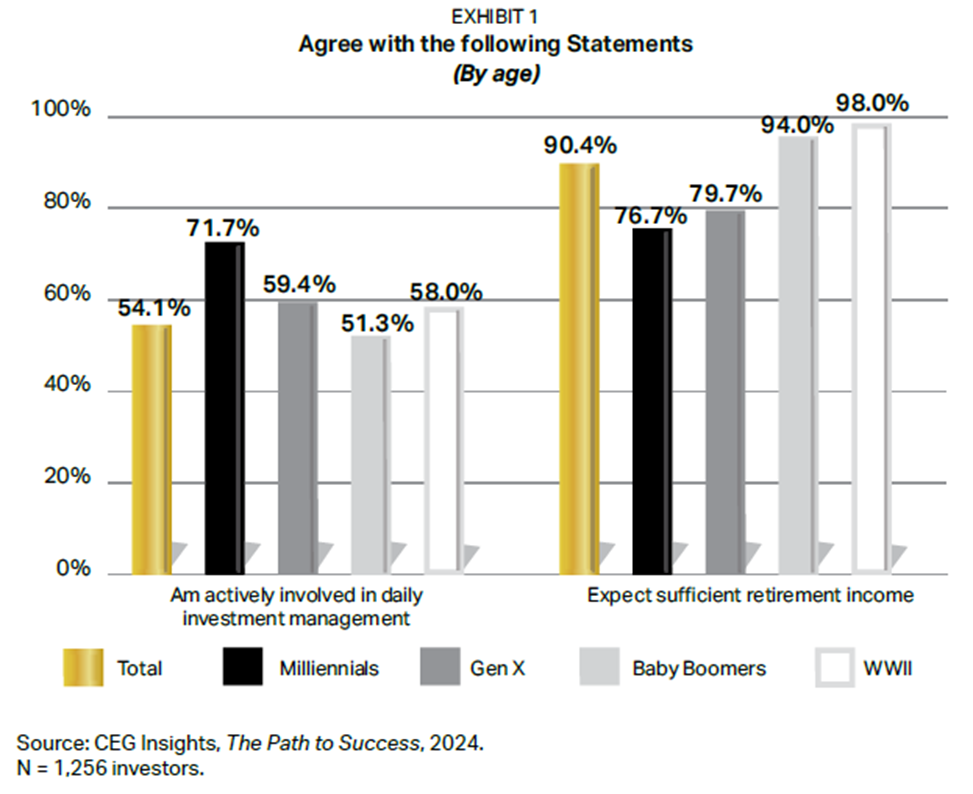
Recently, it seems some investors may be increasingly open to delegating more of their investment activities to their professional advisors. For example, a CEG Insights study from last year (The Path to Success) found that 54% of investors are actively involved in managing their investments daily—a decline from 64.5% observed in the previous year’s study. Notably, millennials demonstrate the highest level of ongoing engagement, with 71.7% actively managing their investments.
There’s no “correct” path when it comes to involvement with your investments. While some like to be very hands-on, others prefer that a professional address all matters. The key is to examine your level of engagement in the investment management process and determine whether it’s where you want it to be.
Question #2: How confident are you in your outlook for retirement?
If your saving and investing goals include a comfortable retirement, how do you feel about your prospects? Of the investors surveyed in The Path to Success report, 90.4% overall expect to be able to generate sufficient income in retirement. Even among the group that’s youngest and farthest away from their golden years—millennials—a full 76.7% expect to have enough retirement income (see Exhibit 1).
One way that some investors evaluate their retirement prospects is to stress test their portfolios—a process that involves questioning existing assumptions about their wealth plans and seeing how their financial picture might look if various scenarios occurred. Stress testing often gives investors greater confidence that they’re on track—or new information that helps them see how they might improve their plans.
Question #3: What are your current financial concerns?
The surveyed investors reported three main financial concerns that were on their minds at the moment: inflation (cited by 79.9% of investors), tax increases (a concern for 72.5% of investors) and stock market performance (59.2% of investors). Anecdotally, we see on a consistent basis that investors tend to be thinking about five main financial issues:
- Wealth preservation—not losing wealth while ensuring there are sufficient funds to maintain their chosen lifestyle
- Wealth enhancement—minimizing taxes and their impact on wealth
- Wealth transfer—ensuring heirs are financially taken care of, in tax-efficient ways
- Wealth protection—preventing wealth from being unjustly taken
- Charitable giving—using wealth to have a positive impact on the world
It can be a good idea to revisit your own list of concerns from time to time, as changes in life can bring certain issues to the forefront while pushing others down the list (or even off it). If a child of yours recently had their first baby, for example, the desire for effective wealth transfer strategies might be a bigger deal now than ever. Regular progress meetings with your advisors are often ideal moments to discuss what’s changed and what that might mean to your financial picture.
Question #4: How do you feel about the amount of investment risk you’re taking?
It’s not uncommon for the investment journey to be bumpy from time to time, particularly for those investors who hold a significant amount of risk assets such as equities. Indeed, the majority of investors surveyed by CEG Insights—56.9%—are concerned about market volatility. If you find yourself worried about the market’s ups and downs, consider taking a look at the level of risk in your portfolio to see whether it’s acceptable to you—taking into account both your tolerance for short-term fluctuations and your plans for the future and the investment growth rate it might take to realize those plans. The “right” balance for you can potentially help you maintain your plan during periods of uncertainty and anxiousness.
Question #5: How are you addressing advanced planning issues you may have?
CEG Insights found that while over half of investors manage their portfolios without trusts, about 35% have incorporated at least one (primarily favoring revocable or living trusts). This usage of trusts—particularly among millennial investors, who are increasingly inheriting such structures—underscores not only generational differences but also a growing sophistication in how younger investors approach wealth preservation.
Despite the evident focus on wealth preservation, a notable disparity remains in managing financial legacies and tax liabilities proactively. While 75% of investors desire to reduce their tax burdens, only 38.5% actively engage with tax professionals to realize this goal. This highlights a significant gap in the implementation of tax efficiency strategies.
Similarly, while six out of ten investors have an estate plan, nearly 40% have undergone significant life changes that necessitate updates to these plans—yet the updates often lag behind these changes. Moreover, asset protection plans are markedly underutilized, with fewer than 20% of investors establishing formal protections and a substantial portion lacking adequate insurance coverage. This gap is most pronounced among Gen X investors and those in higher wealth brackets, who may underestimate their vulnerability to financial risks.
Depending on your non-investment concerns and goals, you may want to examine your current usage of tools aimed at addressing advanced planning issues such as wealth protection and estate planning.
As you consider each of these areas—your level of involvement, retirement confidence, financial concerns, risk tolerance, and advanced planning needs—you begin to form a clearer picture of where you stand today and where you may want to focus your attention moving forward. Even in a busy season, taking a moment to reflect on these questions can help you enter the new year with greater clarity and intention. These insights can also lay the groundwork for productive conversations with your family and your advisors, ensuring your financial strategy continues to support your goals in the months and years ahead.
VFO Inner Circle Special Report
By John J. Bowen Jr.
© Copyright 2025 by AES Nation, LLC. All rights reserved.
No part of this publication may be reproduced or retransmitted in any form or by any means, including but not limited to electronic, mechanical, photocopying, recording or any information storage retrieval system, without the prior written permission of the publisher. Unauthorized copying may subject violators to criminal penalties as well as liabilities for substantial monetary damages up to $100,000 per infringement, costs and attorneys’ fees.
This publication should not be utilized as a substitute for professional advice in specific situations. If legal, medical, accounting, financial, consulting, coaching or other professional advice is required, the services of the appropriate professional should be sought. Neither the author nor the publisher may be held liable in any way for any interpretation or use of the information in this publication.
The author will make recommendations for solutions for you to explore that are not his own. Any recommendation is always based on the author’s research and experience.
The information contained herein is accurate to the best of the publisher’s and author’s knowledge; however, the publisher and author can accept no responsibility for the accuracy or completeness of such information or for loss or damage caused by any use thereof.